The Red Button and More
‘Let your Fitoor talk’ with Sandeep Dikshit
Team Fitoor Magazine
Two hours. That's how long I sat in traffic while the police held the road for a VIP convoy. The laal batti perched atop those cars seemed to mock everything happening below it, the honking, the heat, the helplessness.
Laal.
It's a strange colour to find everywhere in politics, and yet there it is. The red of the communist flag. The red of the Nazi banner. The laal batti of India's powerful. The red button in parliament. Across centuries and continents, red has embedded itself into the political imagination of the world, a colour that commands, warns, and provokes all at once.
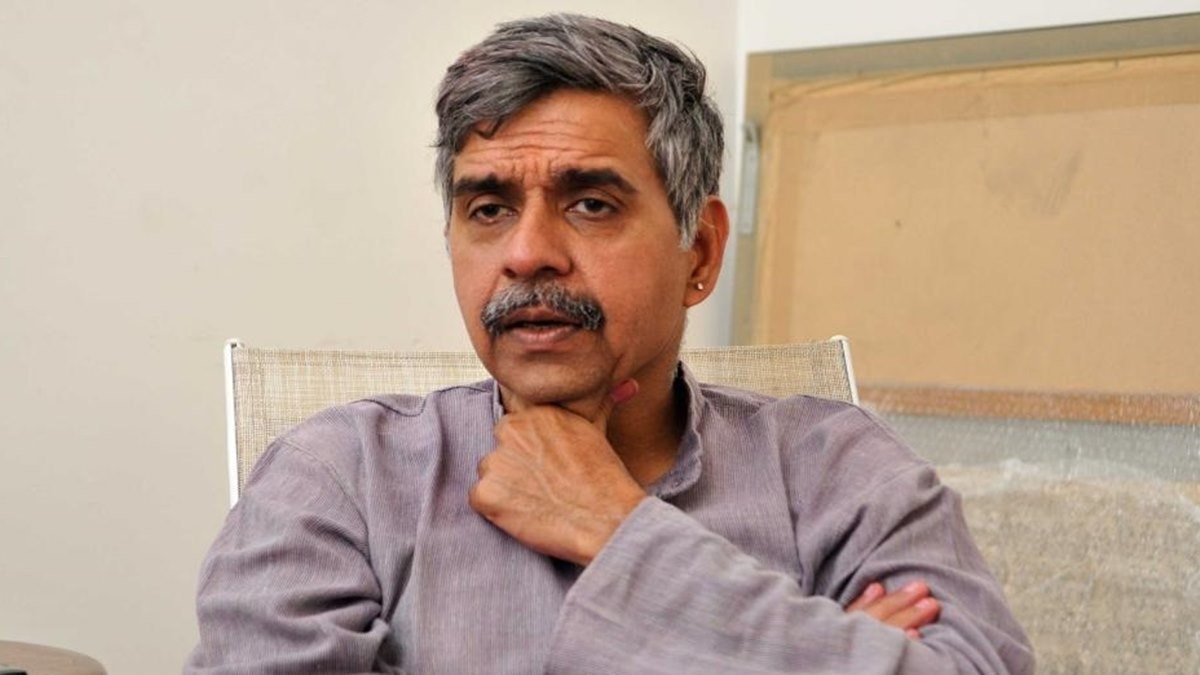
What does it mean here, in India specifically? To explore that question, Fitoor Magazine sat down with Sandeep Dikshit, former Member of Parliament, public policy scholar, and someone who has spent decades thinking about governance from both the inside and the ground up.
Dikshit's career is a rare combination of field work and formal power. After studying history at the University of Delhi and rural management at IRMA, he spent fifteen years with grassroots organisations across Rajasthan, Gujarat, and western India, working on livelihoods and rural development. He later contributed to Madhya Pradesh's human development report and worked extensively on panchayati raj, tribal policy, and local governance. Between 2004 and 2014, he served as an MP. Today, he teaches public policy and modern Indian history at O.P. Jindal Global University while continuing development work in agriculture through his organisation.
In this conversation, he reflects on the many meanings of red, in politics, in power, and in public life.
Q: Red is often described as one of the most politically charged colours, associated with revolution, sacrifice, power and ideology. When you think of red within a political context, what does it represent to you?
A: Well, you know, I grew up and kind of became conscious of myself and politics probably in the late 70s and the 80s. Red basically meant struggle. It was associated with the left and also with the extreme left. That was an era which was just kind of coming out of very fierce nationalism.
The USSR, the Union of Soviet Socialist Republics, was there. The Iron Curtain countries were there. China was there. And to many of us who were youngsters, the left ideology was inspiring.
I was not a communist, but it was inspiring. So red, in a sense, signified struggle against exploitation and loot. It also signified a violent struggle against them. While it was strange for many of us, we deeply believed in Gandhi and his nonviolence. Gandhi, Nehru and others were our heroes. But we were also inspired by the left-led violent forms of revolution.
It was a very emotive and exciting concept. But we did not put violence in the sense of killing people. Violence is the nature of the struggle that changes a system. Something that brings massive change quickly and through forceful means. It did not mean so much socialism as direct communism.
Over time, in the 80s and the 90s, red came to represent the left for many of us of that era. People born in the mid 60s up to the 70s and 80s often saw it that way. It also represented the colour of war, and of course, the colour of blood. But it also meant passion.
When we say someone is red-blooded, it means warm-blooded or passionate. It did not have any sexual connotation, but it certainly meant power and intensity. Someone who was more red-blooded was someone more passionate and energetic. It signified something exciting.
It also did not carry too many negative connotations earlier. Only later did red start being used in different ways. Red corner notice, red as danger, and so on. But red is also the colour of blood, and blood is in many senses the essence of life.
So I have always found it a fascinating colour. Personally, red, orange and yellow have always been my favourite colours. I am also a little biased toward them in terms of my clothes and things like that. That is largely how we saw the colour red.
Q: Red has historically been associated with labour movements, resistance and revolutionary politics. In your view, why did so many political movements adopt this colour as a symbol of their ideology?
A: I think, first of all, it is because red is associated with blood. Blood is associated with passion. Not just the flowing of blood, but the idea of strong feeling and intensity. Through centuries, humankind has associated hot blood or passionate blood with strong emotions and commitment.
Because of that, it also became linked with ideas of progressive thinking or humanised thinking. I am not saying that association is always correct, but that perception exists. So parties or movements that believed they were working toward change or toward a more equal society often adopted the colour red.
In many ways, it was also connected with the idea of equity. Blood is a great equaliser. Everybody has blood flowing through them, although there are different types of blood. But fundamentally, all of us share that same colour of life.
There have also been negative connotations. The issue of race and blood, the idea of blood flowing, or the use of blood imagery in violent abuse. People sometimes say things like khun nikal denge or khun nichod denge, meaning I will take out your blood. So, in some senses, it has not always been used in a positive or welcoming way.
But overall, to me, red has always been a colour that welcomes me in spite of its association with violence. It is a colour that excites me.
Q: Many movements across the world that demand change have historically used the colour red. In the present political climate, do you think such movements still hold the same weight in India?
A: Look, one thing is that thanks to the efforts of India’s founding fathers, much of what happened involved very serious work on building equity on land and bringing in social equity. Although the caste question is still a very important and quite worrying issue.
Perhaps in my younger years, the issues of exploitation, land inequalities and the use of violence to suppress people were much more strongly present in people’s memories. There was also a zeal among people for revolutionary change, much of it coming from the legacy of the freedom movement.
So perhaps violence occasionally got associated with the idea of radical change. Over time, both the experience of such movements and the response of the Indian government, especially in earlier decades, changed the way people approached these struggles.
Even if the government did not respond fully, there was often at least some positive response to movements demanding change. As a result, many movements began to explore nonviolent paths.
Satyagraha, for example, became an important method. Gandhi had shown that it could be a powerful weapon, and many people began to see it as equally effective, if not more effective, in bringing about change.
Large numbers of movements for women’s rights, environmental protection, protests against large development projects, and movements for farmers’ rights adopted nonviolent forms of protest.
Was all of this red in colour? Not necessarily. But the legacy and inspiration that came from movements associated with red continued to influence people, especially those of my generation and those who came after us.
Q: In today’s political landscape, saffron and the tricolour appear to dominate public symbolism. Within this framework, where do you see the place of red?
A: First of all, the tricolour was also important during our time. Just because we did not feel the need to wave a flag at every moment or shout slogans like Bharat Mata Ki Jaya or Vande Matram does not mean we were any less patriotic.
In fact, patriotic people do not necessarily have to display it constantly. Many of us believed that patriotism did not need to be worn on one’s sleeve.
We used the tricolour as much as anyone else. Perhaps we also understood the meaning of the tricolour and what each colour represented, and how each colour has its place.
Saffron today is not really being used as a colour of change or transformation. Instead, it has often become a convenient political tool to invoke religion.
Religion often involves a certain amount of irrational following and blind faith. Political actors sometimes similarly use the colour saffron, hoping that emotional appeal will sustain their power even when their actions may not justify it.
Unfortunately, what has also happened is that there is sometimes a red element in the use of saffron. Violence carried out in the name of religion can lead to bloodshed.
So while saffron may not represent red ideologically, it can still lead to red flowing on our streets. That is perhaps the most unfortunate aspect of how colours are used in politics today.
Q: For many ordinary citizens, red is also associated with the red beacon or laal batti used on official vehicles. How do you see this symbolism in relation to power and privilege?
A: I am really glad you asked this question.
In the 1970s and 1980s, the red light on government vehicles represented authority and law and order. It symbolised the presence of the state and its responsibility to maintain order.
There was also an element of fear associated with it, because the police in India have often functioned as an arm of the state capable of exercising force. But at the same time, there was also a sense of reassurance that order would be maintained.
In those days, the use of the red light was limited. It was mostly restricted to the chief minister or a few senior officials. Even then, people sometimes ridiculed what was called the laal batti culture.
Today, it has become much more widespread and has turned into a status symbol. In a feudal environment, it often serves to distinguish the powerful from ordinary citizens.
Those with the red light can demand privileges on the road and push others aside. In that sense, red has sometimes become a symbol of hierarchy and entitlement.
It has also become a pass for behaviour that ignores civic norms. So the meaning of red in that context has changed quite dramatically.
Q: Looking ahead, what role or meaning could the colour red hold in the future of political life?
A: I think it would be good if red continues to inspire ideas of radical change and progressiveness. It should represent positive feelings and the pursuit of equity.
Red should stand for struggles carried out through enabling mechanisms and constitutional means. It should also be connected more closely with ideas like satyagraha and truth.
While truth is usually represented by the colour white, there is no reason that red cannot also stand for it.
At the same time, its association with violence should decrease. Violence may once have been seen by some as the only way for oppressed people to be heard, although I do not support violence of any kind.Today, the state itself in many parts of the world is becoming increasingly violent in different ways. This violence is not always through bullets, but also through the erosion of rights and freedoms.
In that sense, the red light of the state must also withdraw. Red should become a beacon of law and order for every citizen, rather than a pathway for privilege for the elite.
Q: During your time as a Member of Parliament, did the colour red hold any particular significance within parliamentary life?
A: Not necessarily in a political sense. But there were small ways in which the colour appeared in parliamentary functioning.
For example, when we voted in Parliament, there were red and green lights used in the electronic voting system. If you voted in favour, it showed green, and if you voted against it showed red. If you did not vote, it showed yellow.
I always found that interesting.
There are also colour associations within the two houses. The Lok Sabha is associated with green. Its seating and much of its visual identity use that colour.
The Rajya Sabha, on the other hand, is associated with red. Its seats and some of its visual elements reflect that.
In Western traditions, red is often associated with royalty. But in Indian traditions, royal symbolism has often leaned more toward gold than red.
So in our generation, we never really saw red as a colour of royalty. That association did not exist in the same way for us.